

Written by Joshua Wood (Research Assistant).
I have worked at UCL’s Developmental Risk and Resilience Unit (DRRU) for 3 years now, two of which I spent working on the Prosocial Project. In this blog, I chat to Dr Anne Gaule (Project Lead on the Prosocial Project) and Harriet Phillips (Project Manager and DRRU Lab Manager) about their experiences of being a part of this project. Keep reading to find out more about what the Prosocial Project is all about, why it’s important, and what their experiences have been like working on the project.
The Background
The Prosocial Project explores how adolescent boys process positive social signals, such as laughter and happy faces. Positive social signals are thought to promote connection with others and differences between how people process them may relate to differences in prosocial and antisocial behaviour. The research is carried out using tablet-based software, that measures processing of prosocial signals across different tasks. There is also an aspect of the project that trains perception of ambiguous (neutral/unclear) faces towards happy interpretation over several sessions and measures whether this training reduces antisocial behaviour or increases prosocial behaviour in boys who have “conduct problems”. “Conduct problems” refer to a persistent pattern of antisocial behaviour that violates social norms and exceeds what is typically displayed by this age group. Boys with conduct problems are at a higher risk of leaving education with no qualifications, more likely to become dependent on alcohol and/or illicit substances, and more likely to commit crimes. In order to help boys with conduct problems we need to better understand factors that contribute to their behaviour. This includes studying how they process social signals.
Across the Prosocial Project, 20 mainstream and alternative provision schools participated, with over 200 adolescent boys taking part. As far as conduct problem research goes, this project was on a larger side – given that boys with conduct problems are often hard to recruit for research. We also had the support of amazing schools and teachers, without which the project would not have been possible. It is a testament to the hard-work and perseverance, in the face of a small team and limited resources, of researchers such as Anne and Harriet that allow such amazing research to be conducted that is informative and topical for both schools and society. So, let’s see what they have to say!
The Interview
How it all started
To start, we went back to the beginning of each of their careers and what brought them to working in this area of research. When asked about what initiated their interest in pursuing a career in psychology and both Anne and Harriet highlight a keen interest in understanding human behaviour. Harriet also speaks of an experience that most psychologists likely share, having watched a lot of psychology related media growing up. Her personal favourites being Criminal Minds, Sherlock Holmes and Cracker. Similarly, Anne reflected on memories of reading books at school about how small changes in the way our brains are wired can completely change our perceptions of the world around us and our experiences.

Interestingly, both mention that their love of psychology is partly due to the broad nature of the field and the fact that they can incorporate other passions and interests into their work. Harriet discussed how her studies of law alongside psychology at A-Level resulted in her wanting to study criminal behaviour and forensic mental health. Anne, an enthusiast for literature and languages, found it fascinating how some concepts are only present in certain languages, and that they cannot be directly translated. She was especially interested in how perception can be influenced by cultural context.
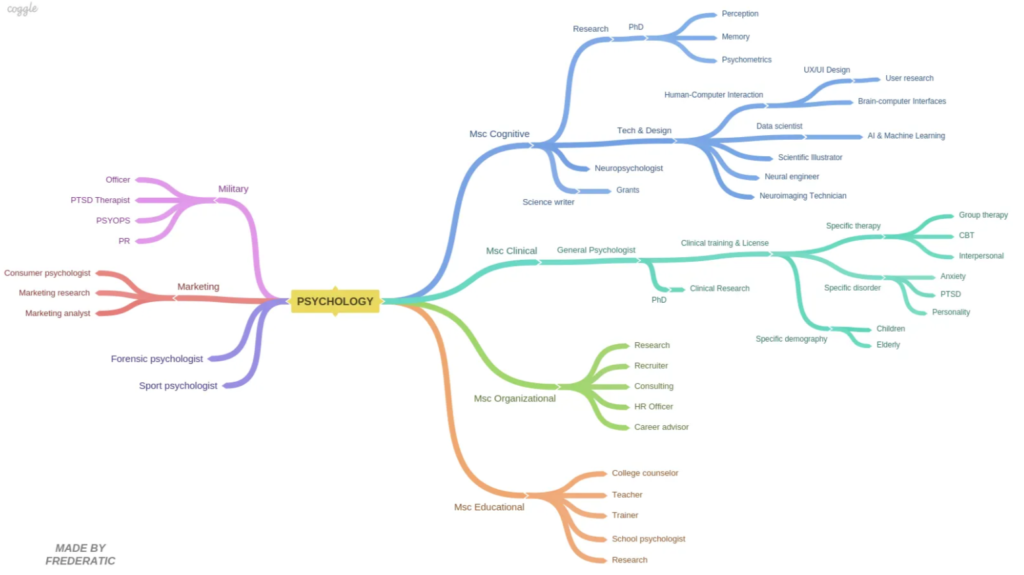
When sitting my A-Levels, I held a narrow perception of what psychology looked like – believing it was all about becoming a clinician or a therapist. I could not be more wrong. Psychology is incredibly broad. Harriet pursued both her interest in psychology and law by studying Forensic Mental Health Research during her Masters, and Anne kept up her love for languages by spending a year studying Brain and Mind Sciences in Paris. I believe it is this that makes a career in psychology so enjoyable. Studying psychology can lead to so many avenues that there will always be something that matches your passions and interests.
Being influenced by their everyday
When asked if their personal interests influence how they work, they discuss how hobbies can have a large impact. Anne rock climbs, voicing how despite not being a natural risk taker, it has taught her to push herself and that problems are an obstacle that can be overcome with hard-work, perseverance and taking a different angle. Harriet highlighted her love for cooking (which is fantastic I must say). Similarly to Anne, Harriet enjoys the problem-solving elements, how to improvise and adapt if an ingredient is missing to make something entirely new.

From incorporating their split interests of law and languages into psychology, as well as incorporating their hobbies into their work, one message seems to prevail: Careers are not necessarily linear – a clear path from A to B. Sometimes there is uncertainty; which path do I follow? What if I regret not pursuing the other? What Anne and Harriet show is that following interests and investing time into hobbies can have positive impacts on not only your wellbeing but also your career.
Conduct problems research
Misconceptions in Conduct Problems Research
Both Anne and Harriet said that the biggest misconception surrounding their research is that people often think that working with young people with conduct problems might be challenging. There exists a great deal of stigma surrounding behavioural disorders, as they are often conflated with just being a “naughty kid”. In our experience as visiting researchers, research sessions were sometimes unpredictable – the reality of working with teenagers – but on the whole the sessions were a joy. Both Anne and Harriet speak on how getting to know and working with the participants was one of their favourite aspects of the project – but more on this in the Inspiration section below.
“People should not be characterised by their worst moments”
~ Dr Anne Gaule
Another misconception is that young people who tend to engage in antisocial behaviour also lack prosocial behaviours. This is not necessarily true and young people’s behaviour has a lot of potential for change. Focusing on positive behaviours, as well as the antisocial ones, is a core feature of the Prosocial Project. In focus groups with young people who took part in the Prosocial Project, several of them pointed out that helping others (whether in their day-to-day or helping us in the pursuit of science!) was a key motivator for them taking part.

Prosocial behaviours are crucial to building good relationships and can have a positive knock-on effect on friendships, interactions with family members, education and work. Although research indicates that some young people with conduct problems can engage less in prosocial behaviours than their peers, this varies person by person and could represent a hugely important target for positively focussed interventions. Therefore, Anne and Harriet both think that it is very important that psychological research focusses on understanding how young people with conduct problems engage in prosocial behaviours as well as antisocial behaviours.
Inspiration
When asked how their work inspires them, they both hold strong feelings about how inspiring it was to work with so many brilliant young people. Watching the young people that we work with open-up and begin to trust us over the course of the project was a privilege to witness and play a part in. Reflecting upon my own time with the Prosocial Project, I couldn’t agree more; I have countless memories of working with these young people, including all the cheekiness, sincerity and laughter, that I still cherish to this day.

Anne and Harriet also emphasised the phenomenal staff that they have worked with. With the busy schedules that teaching staff typically have, it is even more inspiring to see the willingness of staff to provide additional support for the young people we work with. Harriet highlights the importance of involving educators and young people in research, as their knowledge and lived experience can provide valuable insights into future research and policy directions.
Find out more
This blog is not a complete account of the Prosocial Project, for more information regarding the study please visit their website here: Prosocial Project.